Guides
How to choose a marketplace platform: the features that matter
23 October 2026
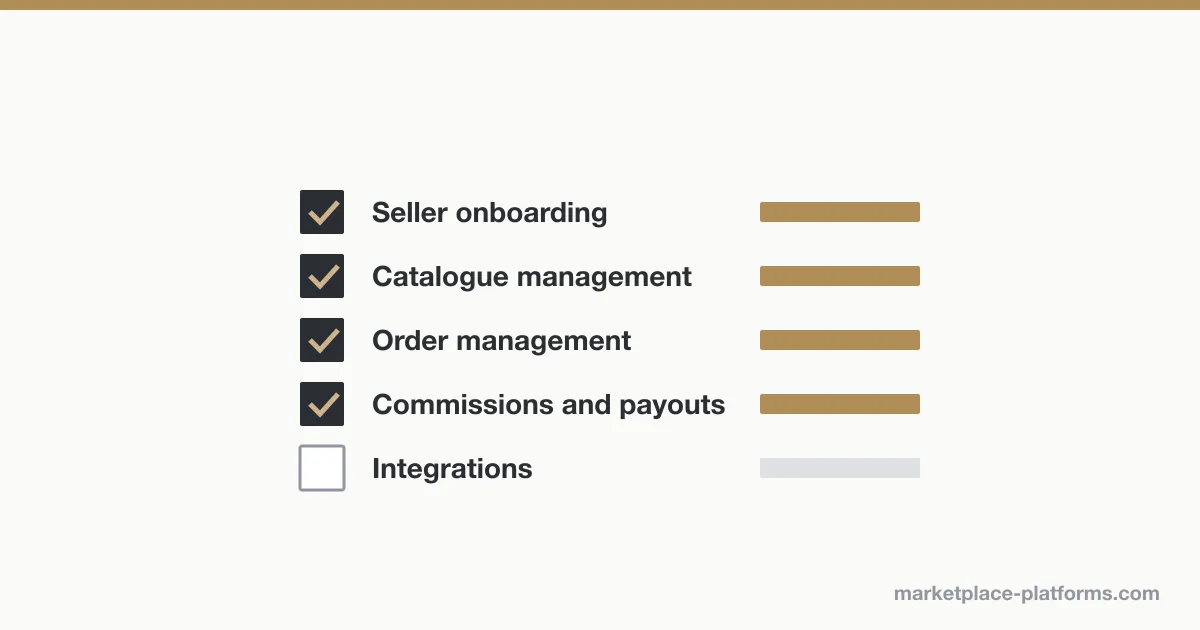
To choose a marketplace platform, start from your operating model — third-party marketplace, dropship or both, B2C or B2B — and whether you keep your current storefront; then check five capabilities (seller onboarding, catalogue management, order management, commissions, split payments), the integrations with your stack, the vendor’s security certifications and customer references, and the three-year total cost. Ask every vendor to demonstrate your own workflows, not a generic demo.
1. The five core capabilities
These are the jobs a marketplace operator does every day. Our ranking checks whether each vendor states them on its own pages:
| Capability | What to check |
|---|---|
| Seller onboarding | Self-service sign-up, identity checks (KYC), contract acceptance, seller portal |
| Catalogue management | Bulk imports, attribute mapping, validation and moderation rules |
| Order management | Split orders across sellers, tracking, returns, cancellations |
| Commission management | Rules by category and seller, invoicing to sellers |
| Split payments and payouts | Who collects the money, who pays sellers, on which schedule |
A capability a vendor does not document publicly is shown as “not stated” in our pages: ask about it directly.
2. Integrations
List the systems the marketplace must talk to — storefront, ERP, product information management, order management, payment provider, tax engine — and check which ones each vendor names. 35 of the 43 platforms state a headless API, which matters if your storefront is custom.
3. Business models
Check that the platform supports every model you plan to run in the next three years: B2C, B2B, dropship, services or digital products. Switching platform later is expensive.
4. AI, retail media and growth features
Vendors increasingly differentiate on AI (catalogue enrichment, seller onboarding, moderation, search, agentic commerce) and on retail media, the advertising sellers buy on your site. 11 platforms in our ranking state retail media.
5. Trust: certifications and references
Ask for ISO 27001 and SOC 2 reports, and for references in your sector and country. A vendor that names large customers on its own site is easier to check.
6. Total cost
See what marketplace software costs. Compare three-year quotes on the same scope.
The shortlist, by score
| Rank | Platform | Score | Type | Pricing |
|---|---|---|---|---|
| 1 | Mirakl | 90.1/100 | Enterprise marketplace platform | Quote-based |
| 2 | Shipturtle | 83.2/100 | Marketplace builder, plugin or script | From 49 USD per month |
| 3 | VTEX | 79/100 | Commerce platform with marketplace module | Quote-based |
| 4 | Origami Marketplace | 71.1/100 | Enterprise marketplace platform | Monthly subscription, quote-based |
| 5 | Marketplacer | 68.6/100 | Enterprise marketplace platform | Quote-based |
| 6 | Yo!Kart | 68.2/100 | Marketplace builder, plugin or script | From 1,999 USD (one-time licence) |
| 7 | Virto Commerce | 66.2/100 | Commerce platform with marketplace module | Subscription based on GMV (from 0.5%) or on orders (from $2 per order), quote on request |
| 8 | Logicbroker | 65.7/100 | Dropship & supplier network | Quote-based (demo / talk to sales) |
| 9 | CS-Cart Multi-Vendor | 64.7/100 | Marketplace builder, plugin or script | From 725 USD per year |
| 10 | Webkul | 63.6/100 | Marketplace builder, plugin or script | From 349 USD (one-time licence) |
Or answer three questions with the platform finder.
Was this guide useful?
Get the next guide and every ranking update by email.
Ranking updates only. Unsubscribe at any time. See our privacy policy.